

Best Bird Photography Lens Recommendations for Tropical Species
Your field-tested framework for choosing the right glass in Colombia's cloud forests and beyond.

Tropical bird photography is one of the most rewarding — and most technically demanding — disciplines in wildlife photography. Whether you're standing in the dew-soaked cloud forests above Cali or navigating the tangled understory near the Yotoco Forest Reserve, the sheer visual brilliance of species like the Multicolored Tanager, Long-tailed Sylph, or Andean Cock-of-the-Rock is matched only by the challenge of actually capturing them on sensor. The global birdwatching tourism market was estimated at USD 70.04 billion in 2025 and is expected to reach USD 117.16 billion by 2033, growing at a CAGR of 6.7% — meaning more photographers than ever are heading into the tropics with a camera, and most of them are discovering the same hard truth: the lens you bring makes or breaks the shot.
In my experience, photographers who show up to a cloud forest destination with the wrong glass spend more time frustrated than shooting. The challenges are real. One of the main problems in tropical forests is the lack of light, which hugely affects the approach to bird photography in the tropics. Add to that the fact that bird photography in a tropical forest is more technically challenging than in the open habitats that photographers commonly encounter in temperate zones or the African Savanna, and you can see why lens selection is so critical. This guide will walk you through exactly what to look for, which lenses are most effective for different scenarios, and how to match your glass to the specific species and environments you'll encounter in places like the cloud forests surrounding Yotoco Lodge.
Key Takeaways
-
Minimum 400mm focal length is essential: General consensus among wildlife shooters is that if you're photographing larger wildlife or big game, you should be equipped with a 300–400mm lens — but birds or smaller subject matter require 500–600mm at least. For tropical forest birds, start at 400mm and go longer where possible.
-
Fast autofocus is non-negotiable: Fast and accurate autofocus is absolutely crucial in bird photography since birds always move unpredictably and quickly. In dappled tropical light, a sluggish AF system will cost you shots that don't come back.
-
Weather sealing protects your investment: Lenses with robust build quality and weather sealing can protect against dust, moisture, and light rain. In humid cloud forest environments, this is a baseline requirement, not a luxury upgrade.
-
Colombia is a global hotspot that demands the right kit: Colombia is home to more birds than anywhere else on Earth, with nearly 2,000 species — hosting 18% of the world's bird species even though its land covers only about 1% of the globe. The diversity demands versatility from your lens system.
-
Zoom lenses win on flexibility: To keep equipment manageable, it is often far easier to take a zoom lens that covers ranges of focal lengths — one solution is to have two zoom lenses, one around 24–120mm and one around 100–400mm, to maximize photographic opportunities.

Quick-Start Prioritization Framework
|
Lens Strategy |
Best For |
Effort Level |
Time to Results |
|---|---|---|---|
|
100–400mm Zoom |
Beginners, feeder setups, short hikes |
Low |
Immediate |
|
150–600mm Budget Telephoto |
Intermediate shooters, canopy & open forest |
Medium |
Days |
|
500mm Prime |
Advanced, low-light understory specialists |
High |
Weeks |
|
600mm f/4 Prime |
Professionals, elusive endemic species |
Very High |
Months |
|
Teleconverter + 400mm |
Budget travelers, extra reach at feeders |
Low–Medium |
Days |
|
Micro Four Thirds 300mm |
Hikers prioritizing portability |
Low |
Immediate |
Start here if you're:
-
A first-time tropical birder: The 100–400mm zoom gives you the feeder-to-canopy flexibility you need with minimal gear weight — fastest ROI.
-
An intermediate photographer at a birding lodge: The Tamron 150–600mm G2 provides reach and sharp results at a mid-level price point without sacrificing image quality.
-
A serious enthusiast or professional: Invest in the Sony FE 600mm f/4 GM OSS or Canon RF 100–500mm L — both built for the demanding light and speed requirements of tropical forest birding.
Understanding the Unique Challenges of Tropical Bird Photography
Before any specific lens recommendation makes sense, you need to understand why tropical bird photography is different — and why the lens rules that apply in open marshes or temperate forests do not always transfer to the cloud forest interior.
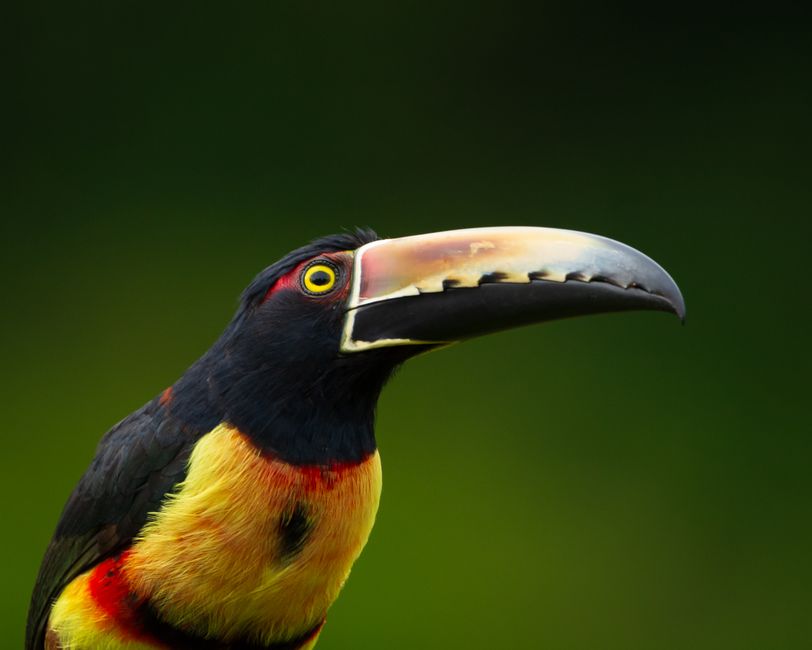
The Low-Light Problem
In the tropical forest you'll have dappled light, harsh light, changing light, and low light on a daily basis. This is the defining challenge. In a closed canopy forest, the aperture can be a real drawback. This means lenses with variable apertures that narrow at long focal lengths — like f/6.3 or f/8 at 600mm — will struggle to deliver the fast shutter speeds needed to freeze birds in motion.
Pro Tip: In tropical cloud forests, aim for a lens with a maximum aperture of f/5.6 or wider at your primary shooting focal length. Anything narrower than f/6.3 at 500mm+ will push you into problematically high ISO values under canopy cover.
There will be times when even pushing your ISO and opening your aperture won't be enough. Some workshop clients say they don't shoot at shutter speeds slower than 1/1000s or 1/500s — but in a rainforest without slow shutter speeds, you may need at least ISO 25,600. Therefore, prioritize lenses that let in as much light as possible and pair them with a modern mirrorless body that handles high ISO cleanly.
Unpredictable Movement and Tight Frames
Capturing crisp, well-composed shots of birds in motion presents several challenges: fast and unpredictable movement — birds change direction, speed, and altitude without warning. In a forest environment, birds are even harder to track than in open sky because branches and foliage constantly interrupt autofocus lock.
Birds are tricky subjects for even the most experienced wildlife photographers — they move quickly, don't stay still for long, and generally won't let you get very close without flying off. Therefore, the best lenses for bird photography need to provide enough magnification to fill the frame with a feathery subject, while also offering fast enough autofocus to track it as it moves — which realistically means a telephoto lens, either a zoom or a prime.
Humidity and Equipment Durability
Even if you avoid direct drenching, the excessive humidity in rainforest environments will always find its way into cameras and lenses. In extreme cases, this can be a severe problem as damaging fungus may form on lens elements or the camera sensor. This is not theoretical — I've found that photographers who underestimate tropical humidity often return home to damaged gear. Every night where possible, put your equipment in a sealed container with a desiccant like silica gel.
Pro Tip: For any tropical bird photography trip, choose lenses with fluorine coating on the front element — it repels water and oils, making field cleaning faster and more effective.
Best Zoom Lenses for Tropical Bird Photography
Zoom lenses are the workhorse choice for most tropical birders. The latest mirrorless cameras come packed with eye-tracking autofocus, ultra-sensitive sensors for low light, high FPS rates, and burst modes that make missing a shot almost impossible. Pair them with the right zoom, and you have a system that can handle everything from hummingbirds at a feeder to toucans in the canopy.

Canon RF 100–500mm f/4.5–7.1 L IS USM
This is one of the most-recommended lenses for tropical bird photography on the Canon RF platform. The Canon 100–500mm is a great lens for bird photography, offering 5 stops of image stabilization, 9 aperture blades for soft gorgeous bokeh, and weighs only 3 lbs. The lens has a 3ft focusing distance and is weather-sealed. That 3-foot minimum focusing distance is particularly useful in a lodge setting where birds approach feeders unexpectedly close.
On a recent trip to the Amazon rainforest, photographer Maxime Aliaga managed to capture beautifully sharp shots of hummingbirds thanks to the Image Stabilisation and fast, accurate autofocus in his Canon EOS R5 and RF lenses. "The EOS R System is a revolution," he says, "because now it's so much easier to get the shot." This combination — Canon RF body with RF telephoto — is considered a best-in-class system for exactly the kind of demanding rainforest conditions you'll find at lodges near the Yotoco Forest Reserve.
Bottom line: If you're a Canon mirrorless shooter visiting Colombia, the RF 100–500mm is the first lens to put on your list.
Nikon NIKKOR Z 100–400mm f/4.5–5.6 VR S
The Nikkor Z 100–400mm f/4.5–5.6 VR S has nine rounded blades, a 77mm filter thread, 0.38x maximum magnification, and a 2.5-foot close focusing distance. It measures 3.9 × 8.7 inches and weighs 1,435g. The lens is weather sealed, offers minimal focus breathing, and has great colors.
For Nikon Z users, this lens is the equivalent of the Canon RF 100–500mm in terms of practical versatility. The NIKKOR Z 100–400mm is a versatile option for hobbyists, remarkably comfortable to handle even on extended shoots. The built-in Vibration Reduction compensates up to 5.5 stops, letting you confidently shoot handheld while maintaining excellent image quality. Its zoom range also provides flexibility to adjust your composition on the go.
Tamron 150–600mm f/5–6.3 Di VC USD G2
For photographers looking for maximum reach on a budget, the Tamron 150–600mm G2 is a legendary option. While using the Tamron SP 150–600mm f/5–6.3 Di VC USD G2, the focusing was found to be faster and more accurate than expected. For the bird photographer on a budget, this lens is surprisingly affordable.
For those on a tighter budget, the Tamron SP 150–600mm f/5–6.3 Di VC USD G2 is a reasonably priced lens offering great performance and reach without breaking the bank, while also having top-notch build quality. The 600mm reach is where tropical bird photography really opens up — you can reach canopy species from the forest floor that would be invisible at shorter focal lengths. If your budget is under $1,500 and you want serious reach, this is your lens.
Pro Tip: When shooting at 600mm in low cloud forest light, use a monopod rather than full handheld shooting. The Tamron G2's VR system is excellent, but a monopod adds that extra stop of stability that turns borderline shots into keepers.
Best Prime Lenses for Tropical Bird Photography
Prime lenses offer superior optical performance, faster maximum apertures, and more precise autofocus at fixed distances. In my experience, photographers who primarily shoot from hides or lodge decks — where the target distance is predictable — often prefer primes for the image quality advantage.
Sony FE 600mm f/4 GM OSS
For those whose wallet allows investment in top-tier equipment, the Sony FE 600mm f/4 GM OSS is a significant investment, but the exceptional image quality, lightning-fast autofocus, and superior build quality make it, in many photographers' opinion, the ultimate bird photography lens. Having f/4 all the way out at 600mm is quite a unique experience.
As the first 600mm prime lens designed for mirrorless cameras, it boasts exceptional image quality, rapid autofocus, and impressive image stabilization. These features combined make it a wildlife photographer's dream lens. It's also remarkably lightweight for a 600mm lens and built to withstand harsh conditions. In the context of tropical bird photography — where your target might be a tiny Chestnut-crowned Gnateater barely visible in deep forest shadow — the f/4 aperture is transformative. This is the professional benchmark for serious tropical bird photographers.
Olympus M.Zuiko 300mm f/4 IS PRO (Micro Four Thirds)
For photographers prioritizing portability on multi-day treks through the Andes, the Micro Four Thirds system is worth serious consideration. For Micro Four Thirds system users, the Olympus M.Zuiko Digital ED 300mm f/4 IS PRO provides a 600mm equivalent focal length in an extremely compact package. It's a go-to lens for bird photography, with outstanding image quality and built-in image stabilization that works in sync with your camera system. The lens is also fully weather-sealed, which helps when unpredictable weather strikes.
The 600mm equivalent reach in a package that weighs under 1.5kg is exceptional. When you're hiking steep hillsides to reach antpitta feeding stations — as is common in cloud forest birding — every gram matters.
Pro Tip: MFT systems give you a 2x crop factor, so a 150–400mm zoom on an MFT body effectively becomes 300–800mm equivalent. This makes mid-range MFT lenses some of the most versatile options for tropical forest environments where distant subjects are the norm.

Teleconverters: Extending Your Reach Without the Weight
Teleconverters effectively increase the focal length of your lens by adding magnifying optics into the light path. These tools can be a boon to wildlife photographers because you can effectively multiply your focal length by 1.4x or 2x without adding too much weight to your rig or necessitating another huge lens.
However, there are real trade-offs. Teleconverters can be used to give the appearance of longer focal length, though these will sacrifice speed and sharpness — two qualities upon which most bird photography heavily relies. Additionally, adding a teleconverter extender to a slow lens especially may cause you to lose automatic focus, which can be problematic for photographers who want to focus quickly on a moving bird.
The practical rule: Use a 1.4x teleconverter on a lens of f/4 or faster. At f/5.6 + 1.4x = effective f/8, which is workable in bright conditions. At f/5.6 + 2x teleconverter = effective f/11, which is too narrow for most tropical forest scenarios.

Lens Features That Matter Most in Tropical Environments
Image Stabilization
Because birds are often in and out of sight within a few seconds, it makes it nearly impossible to use stabilising equipment in most scenarios — so you need to be quick on the draw and will often end up taking photos freehand. This is where image stabilisation lends a hand.
In-body image stabilisation (IBIS) compensates for camera shake by moving the sensor to counteract movement, independently of whether the lens has its own optical stabilisation. IBIS allows you to shoot at slower shutter speeds without blur — valuable in low light when you cannot afford to push ISO further. When combined with optical IS in the lens, the combined effect can be remarkable — sometimes allowing 5–7 stop stability gains. For tropical photographers dealing with dark forest interiors, this is a game-changing advantage.
Autofocus Speed and Bird-Detection AI
Manufacturers have rolled out lenses with advanced image stabilization, lightning-fast focusing, and zoom ranges that would make any bird photographer's heart race. Modern mirrorless systems from Canon (RF), Sony (FE), and Nikon (Z) now include subject-detection autofocus that can lock onto bird eyes specifically. Maxime Aliaga has been impressed with the Eye Detection AF capabilities on bird photography shoots and describes it as beginning a new era in photography.
What this means for you: If you're buying a lens for tropical bird photography today, prioritize one built for native mirrorless mounts (RF, Z, or Sony FE) rather than adapting older DSLR glass. The autofocus integration is significantly better, which directly translates to more keepers.
Weather Sealing in Humid Environments
The environments where the best wildlife photographs are taken are not kind to electronics. Dust from unpaved jungle tracks settles into every gap, and humidity can be oppressive. For tropical bird photography specifically, the ability to shoot in low light is one of the main requirements, as well as high shutter speeds to photograph animals on the move — all while equipment must withstand high heat and humidity as well as the shadowy conditions created by the tree canopy.
Any lens you bring to the tropics should carry formal weather-sealing certification from the manufacturer. This is especially critical in Colombia's cloud forest environments, where rainfall can occur any time of day.
Pro Tip: Even weather-sealed lenses benefit from a rain cover sleeve, available for under $30. Use it proactively — don't wait for the downpour to start. The Yotoco cloud forest and surrounding areas around Yotoco Lodge are known for fast-changing weather that catches unprepared photographers off guard.
Matching Lens Choice to Specific Tropical Bird Scenarios
Different tropical bird photography scenarios demand different focal strategies. Here's how to think about your glass choice before you arrive in the field.

Hummingbird Feeder Photography (Lodge Settings)
At well-managed birding lodges, hummingbird feeders bring birds to within 1–4 meters of your position. Around many lodges, birds and some mammals can be approachable, so a lens of 300–400mm will certainly produce decent frame-filling images, especially if your camera body has a crop sensor. Many lodges in Central and South America have hummingbird feeders, and long telephoto lenses are ideal for isolating the birds against an uncluttered background.
For feeder photography, a 100–400mm zoom is ideal. The short minimum focusing distance lets you fill the frame even at the closer end of the zoom range, and the flexibility to zoom out for contextual shots is invaluable. Hummingbirds move fast — use high shutter speeds of 1/2000 or faster and flash diffusers to freeze motion while keeping a natural look.
At destinations like Yotoco Lodge, feeders attract a spectacular array of species. In the cloud forest around this region, over 300 species and 4 endemic birds have been spotted, and you can easily photograph up to 17 species of hummingbirds and up to 30 species of tanagers, flower piercers, and honeycreepers. For this kind of concentrated diversity, a versatile zoom wins over a prime every time.
Deep Forest and Canopy Species
For forest-interior species — antpittas, gnateaters, motmots, quetzals — you'll often be working at greater distances with significantly less light. Cloud forests are among the most iconic bird photography locations in Colombia — rich in biodiversity and home to many colorful and unique bird species. To succeed here, photographers must use fast lenses, higher ISO settings, and quick reflexes. Patience and observation are essential.
In these conditions, use a telephoto lens of 400mm–600mm and increase ISO slightly to capture movement in low light. A 500mm or 600mm prime is the professional choice here, but a quality 150–600mm zoom will serve most photographers well.
Birds in Flight Over Open Areas
For birds crossing open skies — raptors, swifts, parrots, or the Andean Cock-of-the-Rock at a lek — you need fast burst rates and reliable continuous autofocus more than ultimate focal length. When photographing birds in flight, equipment has to find the right balance between weight, autofocus speed and accuracy, and image quality.
Use 1/2000s+ shutter speed to freeze movement, switch to AF-C (Continuous Focus) for real-time tracking, choose Zone AF or Wide-Area Focus to maintain focus accuracy, pan smoothly with the bird's flight path, and use burst mode (10+ FPS) to capture the perfect wing position. A 100–400mm or 100–500mm zoom is actually preferred for flight shots because the zoom flexibility lets you frame the bird correctly as it moves toward or away from you.
Pro Tip: When photographing endemic species at established Colombia birding locations near Yotoco Lodge, scout the site the evening before your shoot. Learn the flight paths, perching locations, and light conditions so you can preset your camera and lens for the optimal moment — not scramble to adjust when the bird appears.
Common Lens Mistakes to Avoid in Tropical Bird Photography
Going Too Long Without a Feeder Setup
Many first-time tropical birders assume that longer always means better. While recommending lenses with at least 400mm focal length on a full frame camera body for bird photography is common, 400mm is not that long still when you consider how many advanced photographers choose lenses of at least 500mm or more — yet shorter lenses work fine at duck ponds where birds are friendly and will approach. The point: match your focal length to your actual shooting scenario, not to the longest lens you can carry.
Skipping Weather Protection for "Just a Short Walk"
Even on days when there is no rain, kit gets covered in moisture, especially around waterfalls. At the end of each day, take the time to dry and clean your gear. The Yotoco cloud forest is perpetually misty — "just a short walk" regularly turns into a full gear-soaking experience. Never leave the lodge without your rain sleeve and a dry microfiber cloth in your vest pocket.
Relying on Teleconverters in Low Light
That 800mm reach gives incredible reach for the money, but f/11 is really demanding on your ISO when the clouds roll in or you're under a heavy canopy. This is the single most common gear mistake I encounter on tropical bird photography expeditions. A 2x teleconverter can sound like a free 600mm upgrade, but in practice, the aperture penalty makes it impractical for deep forest shooting.
Choosing Weight Over Optical Quality
If you had the choice of a top-of-the-line camera with a medium quality lens, it's better to choose the best quality lens with a lesser quality camera. Cameras are replaced every few years; a great lens will outlast multiple camera bodies. Since photographers often find themselves in remote locations, the weight of the lens is an often overlooked but significant factor. Carrying heavy gear can be tiring and may limit how long you can stay out shooting. Balance optical quality against realistic field mobility — especially on steep Andean trails.

Frequently Asked Questions
What is the minimum focal length for tropical bird photography?
When capturing images of wild birds, it is best to use a telephoto lens with a long focal length of 250mm or greater. However, for tropical species in dense forest where you cannot approach closely, 400mm is a more realistic minimum. At feeder setups, a 300mm on a crop sensor body is workable — but for canopy and understory species, you'll want 500mm or more. Therefore: start at 400mm and budget for a longer option once you understand your primary shooting scenarios.
Do I need weather-sealed lenses for cloud forest bird photography?
Yes, definitively. Equipment must withstand high heat and humidity as well as the shadowy conditions created by the tree canopy. The combination of high humidity, unexpected rain showers, and mist in cloud forest environments means that non-sealed lenses face very real risk of moisture ingress and fungal damage. Weather sealing should be considered mandatory, not optional, for any tropical birding trip.
Is a zoom or prime lens better for tropical birds?
Both have a place in your kit, but for most general tropical bird photographers, a quality zoom wins on versatility. Choosing between a zoom lens and a prime lens depends on what you value more: flexibility and convenience, or optical performance and speed. Both have strong use cases in wildlife photography. At lodge feeders and on trails where distance to subjects varies rapidly, a zoom lets you adapt. If you primarily shoot from hides or fixed platforms where subject distance is predictable, a prime's extra aperture is worth it.
How important is image stabilization for tropical bird photography?
Extremely important. Image stabilisation is either an in-camera or in-lens feature that counteracts your movements to ensure you get a clear image. In dark tropical forest interiors where you're forced to use slower shutter speeds than ideal, a lens with 4–5 stops of optical stabilization is the difference between acceptable and unusable images. Prioritize lenses with the latest IS/VR/OSS generations, which offer better subject-tracking modes alongside raw stabilization power.
What lenses do photographers use for hummingbirds specifically?
Hummingbirds at feeders can be photographed at surprisingly short distances, so a 100–400mm zoom is often ideal. Hummingbird feeders by the lodge are good for multi-flash as well as getting clean shots of perched birds, with possibilities including Long-tailed Sylph, Bronzy and Collared Incas, Tourmaline Sunangel, and Fawn-breasted Brilliant. For hummingbirds in flight, use the fastest shutter speed your lens allows — 1/2000s minimum — and lean on continuous AF tracking.
Can I use my crop sensor camera body with these lens recommendations?
Yes, and in many cases a crop sensor (APS-C) body is an advantage. A 'crop sensor,' such as APS-C or 4/3rds, will increase the apparent magnification of your telephoto, giving you more magnification for your money. A 400mm lens on an APS-C body delivers a 600mm equivalent field of view — a significant boost that makes entry-level lenses perform like mid-range telephoto options.
How much should I budget for a bird photography lens for a tropical trip?
In the past, bird photography was reserved for those with very deep pockets, with long prime lenses costing more than $8,000. However, with the advent of relatively inexpensive super-zoom lenses from Sigma and Tamron, and even some from the mirrorless camera makers, it is much easier to get into bird photography these days. For a first-time tropical birding trip, a budget of $800–$1,500 gets you a capable zoom (Tamron 150–600mm G2 or equivalent). For serious work, $2,500–$4,000 buys a premium zoom (Canon RF 100–500mm, Nikon Z 100–400mm S). Professional prime lenses (Sony 600mm f/4 GM, Canon RF 600mm f/4 L) run $13,000+ and are reserved for dedicated specialists.
Conclusion: Invest in the Right Glass Before You Arrive
Tropical bird photography at locations like the cloud forests surrounding Yotoco Lodge is unlike any other photography experience — the species diversity, the color intensity, and the sheer unpredictability of the environment make every session unique. Since 2010, global birdwatching activity has increased dramatically, particularly in countries with the highest numbers of small-range birds — and while the overall number of birdwatching tourists grew in most tropical countries, the proportion of global birding tourism remained flat or declining for all except Colombia. Colombia is the world's hottest bird photography destination right now, and the photographers getting the best images are the ones who showed up prepared.
The right lens doesn't have to be the most expensive one. It has to match your shooting scenarios: the focal length covering your likely subject distances, the aperture surviving your target light conditions, the weather sealing protecting your gear from inevitable humidity, and the autofocus speed keeping pace with birds that don't wait. Start with the lens you can afford, shoot every session you can, and upgrade strategically as your skills and specific needs become clear.
Yotoco Lodge sits at one of the most species-rich birding crossroads in the world — make sure your glass is ready for what awaits.
Sources
-
Best Lenses for Bird Photography and Wildlife in 2026 — Digital Camera World. Expert tested telephoto lens recommendations for birders. https://www.digitalcameraworld.com/buying-guides/best-lenses-for-bird-photography
-
Best Lenses for Bird Photography (2025) — Better With Birds. Field-tested lens reviews by professional nature photographers. https://betterwithbirds.com/blogs/bird-photography-and-sound-tips/best-lenses-for-bird-photography
-
5 Best Lenses For Bird Photography — The Phoblographer. https://www.thephoblographer.com/2025/05/31/5-telephoto-lenses-perfect-for-bird-photography/
-
5 Best Lenses for Bird Photography, Budget to High-End — AVI Birds. https://avibirds.com/best-bird-photography-lenses/
-
Best Lenses For Bird & Wildlife Photography In 2025 — Sony Alpha Universe. https://alphauniverse.com/stories/best-lenses-for-bird-and-wildlife-photography-in-2025/
-
Bird Photography in the Tropics: A Brief Guide — Whitehawk Birding. https://www.whitehawkbirding.com/bird-photography-in-the-tropics/
-
Bird Photography Tips and Tricks — Photography Life. Bird Photography Tips and Tricks — Photography Life
-
Bird Photography How-Tos — Audubon Society. Expert guidelines for bird photographers. Bird Photography How-Tos — Audubon Society
-
The Ultimate Beginner's Guide to Bird Photography — PetaPixel. https://petapixel.com/2025/09/03/the-ultimate-beginners-guide-to-bird-photography/
-
Colombia Bird Photography Tour — Tropical Birding. Colombia Bird Photography Tour — Tropical Birding
-
Best Birding Hotspots in Colombia for Wildlife Photography — Retorno Photo Tours. https://www.retornophototours.com/the-best-birding-hotspots-in-colombia-for-wildlife-photography
-
Understanding Bird Habitats in Colombia — Retorno Photo Tours. https://www.retornophototours.com/understanding-bird-habitats-in-colombia-for-better-photography-outcomes
-
Rainforest Photography: A Guide to Equipment — Nature TTL. https://www.naturettl.com/rainforest-photography-equipment/
-
Top Tips for Bird Photography in Jungle and Low Light — Rockjumper Birding. https://www.rockjumperbirding.com/5-top-tips-bird-photography-jungle-low-light-conditions/
-
Choosing a Lens for Wildlife Photography — B&H Photo. Choosing a Lens for Wildlife Photography — B&H Photo
-
Best Lens for Wildlife Photography (2026) — Cool Wildlife Photography. Best Lens for Wildlife Photography (2026) — Cool Wildlife Photography
-
Close Encounters: Choosing the Right Telephoto Lens for Birding — Nikon Asia. Close Encounters: Choosing the Right Telephoto Lens for Birding — Nikon Asia
-
Rainforest Photography — Hummingbird Story — Canon Europe. Rainforest Photography — Hummingbird Story — Canon Europe
-
A Bird in the Bush: How To Shoot Rainforest Birds — Australian Photography. https://www.australianphotography.com/news/a-bird-in-the-bush-how-to-shoot-stunning-shots-of-rainforest-birds
-
Camera Features Essential for Capturing Wildlife — Yogesh Wildlife Photography. https://yogeshwildlifephotography.com/camera-features-essential-for-capturing-wildlife/
-
Birdwatching Tourism Market Size Report — Grand View Research. Birdwatching Tourism Market Size Report — Grand View Research
-
Colombia Bird Species — Birding Tours Colombia. https://birdingtourscolombia.com/the-birds/
-
Colombia 21 Day Birding Photography Trip — Birding and Wildlife Safaris. https://www.birdingandwildlifesafaris.com/activities/colombia-21-day-birding-photography-trip/
-
Birdwatching Tourism is Booming — UC Santa Cruz News. Birdwatching Tourism is Booming — UC Santa Cruz News
-
What is a Birding Photography Tour in Colombia — Sula.com.co. [https://www.sula.
0 comments